


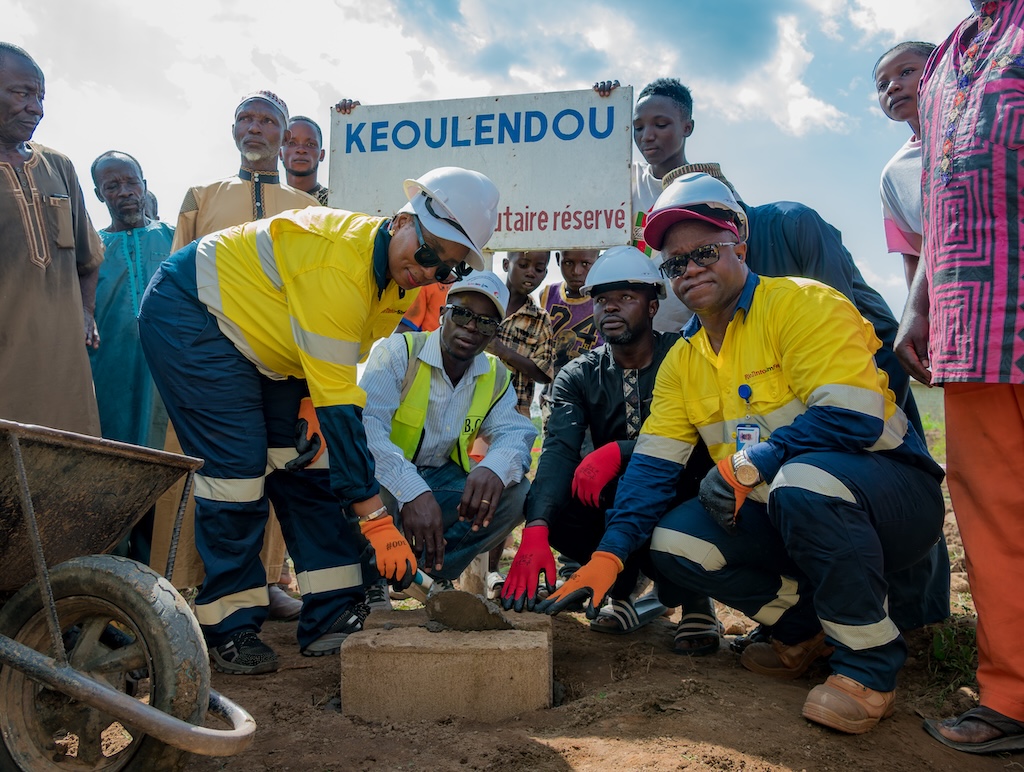
Beyla, Guinea — Rio Tinto SimFer, the joint venture between the Government of the Republic of Guinea, Rio Tinto and the Chinalco-led consortium (CIOH), has launched a series of community development initiatives aimed at strengthening socio-economic resilience in communities affected by the Simandou iron ore project. The announcement was made during a ceremony in Beyla, where 120 women and young girls received certificates after completing a one-year vocational training program in soap production, sewing, and hairdressing.
The new initiatives form part of SimFer’s broader commitment to local content development and sustainable community investment around one of Guinea’s most strategic mining projects. The programs focus on improving access to essential services, creating economic opportunities, supporting youth employment, empowering women, and promoting sustainable agriculture.
Among the key projects launched are the establishment of a digital inclusion center in Beyla, the development of 40 hectares of market gardens across 25 villages, the training of 360 young graduates in project development and resource mobilization, and the construction of 40 manual boreholes to improve access to clean water.
For Guinea, these initiatives represent an important dimension of mining development: ensuring that large-scale mineral projects generate tangible benefits beyond production and exports. As Simandou moves closer to becoming a major global iron ore supply hub, community investment will be essential to ensuring that local populations participate in the economic transformation expected from the project.
Building Local Economic Capacity
The training of 120 women is particularly significant in a region where women often face limited access to formal employment and business opportunities. By equipping participants with practical skills in sewing, hairdressing, and soap manufacturing, SimFer is helping create pathways toward entrepreneurship and household income diversification.
Such programs can contribute to the development of local small and medium enterprises (SMEs), which are critical for sustaining economic activity around mining operations. Beyond direct employment, successful mining regions depend on a strong local business ecosystem capable of supplying goods and services to communities and mining companies.
The planned training of 360 young graduates in project development and resource mobilization is another strategic intervention. Guinea has a young population with significant entrepreneurial potential, but many young people lack access to technical guidance, financing networks, and business management skills. Strengthening these capabilities can help transform ideas into viable businesses and reduce dependency on mining employment alone.
Agriculture, Water Access, and Community Resilience
The agricultural component of SimFer’s community program also addresses a major challenge in mining regions: ensuring that economic growth does not weaken traditional livelihoods. The creation of 40 hectares of market gardens across 25 villages can improve food security, increase local agricultural production, and create additional sources of income.
For mining communities, agricultural development is particularly important because it supports economic diversification. A balanced regional economy should combine mining activities with agriculture, services, logistics, and local entrepreneurship to create long-term resilience after the mining cycle.
Similarly, the construction of 40 boreholes represents a direct investment in public health and living conditions. Access to safe water reduces health risks, improves productivity, and contributes to better educational outcomes, especially for women and children who often carry the responsibility of water collection.
The Role of Government and Mining Companies
While these initiatives are positive steps, their long-term success will depend on strong coordination between SimFer, the Guinean government, local authorities, and communities. Community development programs should be integrated into broader regional development planning to avoid isolated projects that disappear after initial funding ends.
The Government of Guinea has a key role in ensuring that mining investments contribute to national development objectives. This includes strengthening local governance, improving infrastructure planning, supporting vocational training systems, and creating a business environment where local entrepreneurs can grow.
For mining companies, the priority should be moving beyond corporate social responsibility toward genuine shared-value partnerships. Sustainable mining development requires continuous dialogue with communities, transparent decision-making, local procurement strategies, and investments that remain beneficial throughout and beyond the life of the mine.
Simandou project has the potential to become a transformative industrial development for Guinea. However, its ultimate success will not only be measured by iron ore production volumes or export revenues, but also by improvements in living standards, employment opportunities, skills development, and economic empowerment for Guinean communities.
SimFer’s latest initiatives demonstrate an important direction for the future of mining in Guinea: combining resource development with inclusive growth to ensure that mineral wealth contributes to lasting national prosperity.
Share on social media

-