


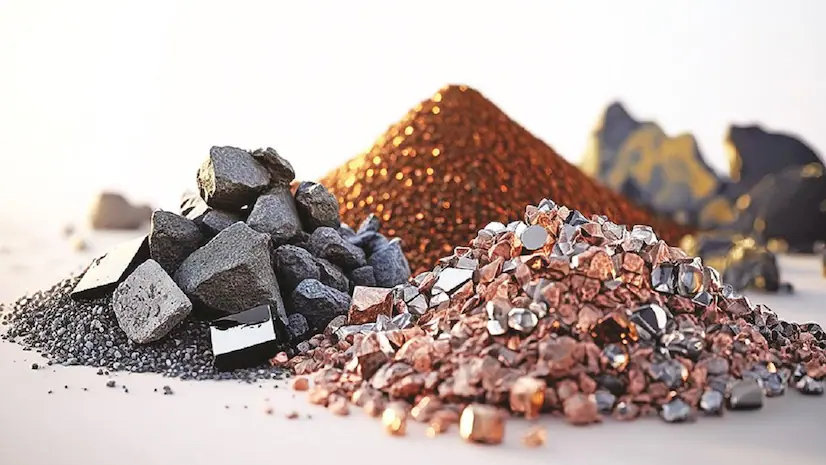
The global mining industry is undergoing a profound transformation as governments and industries compete to secure access to critical minerals essential for the energy transition, advanced manufacturing, digital technologies, and national security. From electric vehicles and renewable energy systems to artificial intelligence, semiconductors, and defense applications, the minerals that power modern economies have become strategic assets, triggering what many analysts describe as a new global race for resources.
At the center of this race are minerals such as lithium, cobalt, nickel, graphite, copper, manganese, rare earth elements, and high-grade iron ore. Demand for these resources is accelerating as countries pursue ambitious decarbonization targets and invest heavily in clean energy infrastructure. Electric vehicles require significantly more minerals than conventional vehicles, while wind turbines, solar panels, battery storage systems, and power transmission networks depend on large quantities of mineral inputs.
The race for critical minerals is not solely about resource availability. It is increasingly driven by concerns over supply-chain security. Many industrialized economies remain dependent on a limited number of countries for the extraction, processing, and refining of critical minerals. As geopolitical competition intensifies, governments in North America, Europe, and Asia are seeking to diversify supply sources and establish strategic partnerships with resource-rich nations.
This evolving landscape presents a significant opportunity for Guinea, a country already recognized as one of the world's most important mining jurisdictions. While Guinea's reputation has traditionally been built on its vast bauxite resources, the country is increasingly emerging as a strategic player in the broader critical minerals economy.
Guinea possesses the world's largest known reserves of bauxite, the primary raw material used to produce aluminium. As global demand for lightweight and recyclable materials grows, aluminium is becoming increasingly important in electric vehicles, renewable energy infrastructure, aerospace manufacturing, power transmission systems, and sustainable construction. Guinea's bauxite sector therefore occupies a critical position in global supply chains supporting the energy transition.
The country's strategic importance is further reinforced by the Simandou project, one of the world's largest and highest-grade undeveloped iron ore deposits. As the steel industry seeks to reduce carbon emissions, demand is growing for premium-grade iron ore capable of producing lower-emission steel. Simandou's exceptionally high iron content positions Guinea as a future supplier of a resource that could play a major role in the decarbonization of global steel production.
However, Guinea's mineral potential extends well beyond bauxite and iron ore. The country hosts substantial gold resources and remains one of West Africa's leading gold producers. Gold continues to attract investment as a store of value and is increasingly utilized in electronics, telecommunications equipment, and advanced technologies requiring highly conductive and corrosion-resistant materials.
Guinea is also endowed with significant diamond deposits, particularly in the southeastern regions of the country. Beyond their traditional role in the jewelry market, industrial diamonds are widely used in mining, drilling, cutting, polishing, and high-precision manufacturing applications.
More importantly, geological surveys and exploration activities have identified promising occurrences of minerals increasingly classified as critical to the global energy transition. These include graphite, nickel, cobalt, manganese, lithium-bearing pegmatites, and rare earth element prospects. While these resources remain less developed than Guinea's bauxite industry, they offer substantial opportunities for future exploration and investment.
Graphite is a key component in lithium-ion batteries used in electric vehicles and energy storage systems. Nickel and cobalt are essential ingredients in high-performance battery technologies, while manganese plays a growing role in both steelmaking and next-generation battery chemistry. Rare earth elements are indispensable for the production of permanent magnets used in electric motors, wind turbines, consumer electronics, and defense systems.
The presence of these minerals positions Guinea to become more than a bulk commodity exporter. With the right policies and investments, the country could develop into a diversified supplier of strategic minerals required by the industries of the future.
To capitalize on this opportunity, Guinea must continue improving its mining investment environment while accelerating efforts to promote local value addition. Projects such as alumina refineries, mineral processing facilities, industrial zones, and supporting infrastructure can help increase the economic benefits retained within the country. At the same time, exploration programs should be expanded to better define and develop Guinea's critical mineral potential.
Mining companies also have an important role to play. Beyond resource extraction, investors should prioritize local content development, workforce training, technology transfer, and community engagement. Sustainable mining practices and transparent governance will be essential to maintaining investor confidence and ensuring that mining contributes to long-term national development.
As the global race for critical minerals intensifies, Guinea finds itself in a uniquely advantageous position. With world-class bauxite reserves, the transformative Simandou project, established gold and diamond sectors, and emerging potential in battery and technology minerals, the country possesses many of the resources needed to support the global energy transition. The challenge now is to convert this geological wealth into sustainable economic growth, industrial development, and lasting prosperity for the Guinean people.
Share on social media

-