


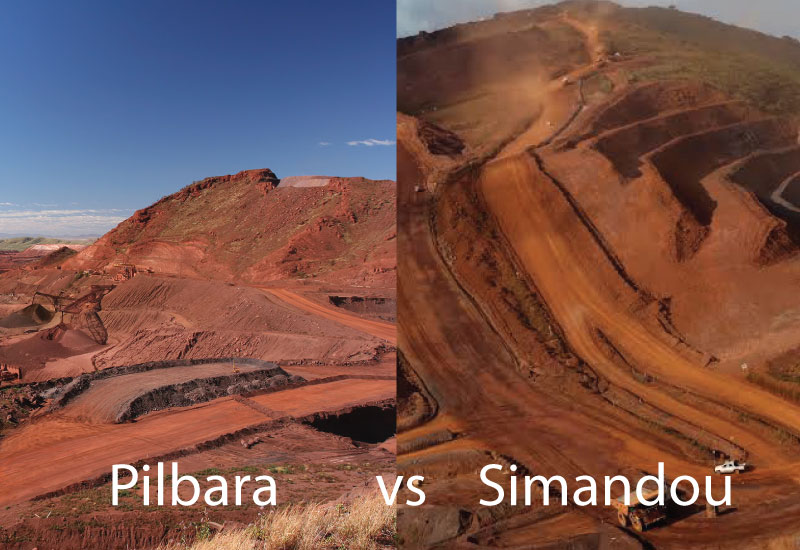
A single word has been doing a lot of work in iron ore markets this year: "Pilbara killer." It resurfaced in force after analyst Carl Capolingua examined the mid-2026 iron ore sell-off and asked whether Guinea's Simandou project is finally the mine that ends Australia's three-decade grip on seaborne supply. For an audience of mining actors watching both jurisdictions, the answer that emerges from the data is more nuanced than the headline suggests — and it matters for how Guinea positions itself in the years ahead.
What triggered the scare
Capolingua's analysis traces the SGX iron ore futures price falling from a two-year high above US$111 a tonne in May to under US$97 by late June, a drop of roughly 13% in six weeks, dragging down BHP, Rio Tinto, Fortescue and Champion Iron shares with it. The proximate cause was ramp-up data out of Guinea: shipments that broke through 1.2 million tonnes in a single month for the first time, then, according to UBS estimates cited in the piece, accelerated to an annualised run-rate near 30 million tonnes by May — more than double the pace of the prior quarter and well ahead of UBS's own 22-million-tonne forecast for the year.
Independent reporting supports the picture of an unexpectedly fast start. Fastmarkets' Iron Ore Decoded panel in early July put Simandou's daily shipment rate at around 70,000 tonnes, tracking toward the upper end of a 50–60 million tonne annualised baseline despite a slower opening to the year, while Wood Mackenzie's own 2026 projection sits lower still, at roughly 16 million tonnes for the full year. That spread between forecasts is itself instructive: even specialists tracking the same mine disagree by a factor of two or three on how fast it will scale, which is exactly the kind of expectations gap that jolted the futures price in the first place.
Why "killer" overstates it
The case against a Pilbara knockout blow rests on three points Capolingua's article draws out. First, scale: Rio Tinto's iron ore chief Matt Holcz has argued that the seaborne market must replace some 800 million tonnes of depleting mine capacity over the coming decade, against which even a fully ramped Simandou — commonly cited at up to 120 million tonnes a year eventually, split between the Rio Tinto-backed SimFer venture and the Chinese-led Winning Consortium Simandou — covers only around a sixth of that gap. Rio's first-half 2026 results, reported this week, reinforce that this is additive rather than cannibalistic for the group: the company posted record first-half Pilbara iron ore production alongside continued Simandou construction progress, with the mine and port now past three-quarters complete and rail fully commissioned.
Second, product differentiation. Simandou's ore grades close to 65% iron, compared with the 58–62% typical of Pilbara fines, according to Wood Mackenzie's 2026 outlook. That higher grade is increasingly prized by steelmakers pursuing decarbonisation and the shift toward direct reduced iron and electric-arc furnace routes, which use less energy per tonne of high-grade feed. Rather than displacing Pilbara tonnes outright, Simandou is expected to serve a premium niche and give steelmakers more sourcing optionality — reinforcing pricing for high-grade product rather than collapsing the market for standard fines.
Third, and most durable, is cost. Capolingua cites UBS placing the current price only about 5% inside the global cost curve, meaning roughly 85 million tonnes of high-cost, largely diesel-dependent supply already sits near breakeven — tonnage that gets forced out before benchmark prices can fall much further. BHP and Rio Tinto's low position on that curve is precisely why brokers surveyed in the article remain broadly constructive on the majors even as forecasts get trimmed.
The takeaway for Guinea
None of this diminishes Simandou's significance — Wood Mackenzie calls it the primary catalyst for long-term seaborne supply growth, and projections suggest Guinea could eventually capture a high-single-digit share of the global trade. But the more accurate framing for Guinean mining stakeholders is complementary growth alongside the Pilbara, not replacement of it. The near-term variable to watch domestically is Guinea's wet season, which has already begun trimming loadings at the Morebaya stockpile; how smoothly the ramp continues through the rains, more than any single month's shipment figure, will determine whether Simandou consolidates its premium-grade niche or feeds fresh volatility into a market still searching for its post-ramp equilibrium.
Share on social media

-