


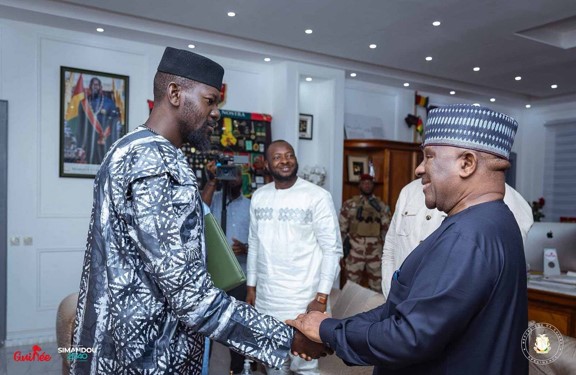
Conakry - Guinea’s ambition to move beyond being a major exporter of raw minerals continues to attract some of Africa’s most influential industrial investors. The latest indication came with the visit of Nigerian billionaire and BUA Group Executive Chairman Abdul Samad Rabiu, who held high-level discussions with President Mamadi Doumbouya in Conakry on opportunities to unlock the country’s mineral and agricultural potential through strategic partnerships and industrial development.
While no investment agreements were announced during the visit, the meeting is significant in the context of Guinea’s ongoing drive to attract long-term industrial investors capable of supporting value addition, infrastructure development, and economic diversification. According to information released following the meeting, discussions focused on leveraging Guinea’s natural resources, developing agriculture, and strengthening intra-African economic cooperation through localized investment.
A Second Nigerian Industrial Giant Eyes Guinea
Rabiu’s visit comes only weeks after fellow Nigerian billionaire Aliko Dangote visited Conakry to discuss investment opportunities in mining, energy and other strategic sectors with the Guinean government. Dangote reiterated his group's confidence in Guinea and its intention to explore investments that could contribute to the country's economic transformation.
The back-to-back visits by Nigeria's two largest industrial groups are unlikely to be coincidental. Together, they suggest that Guinea is increasingly positioning itself as one of Africa's most attractive destinations for large-scale industrial investment beyond traditional mining operations.
For mining stakeholders, this trend deserves close attention.
Beyond Mining Extraction
Unlike conventional mining companies, BUA Group is an industrial conglomerate with interests spanning cement, infrastructure, ports, agriculture and manufacturing. This profile is particularly relevant for Guinea as the country seeks to capture greater value from its abundant mineral resources rather than relying solely on exports of raw ore.
Guinea possesses the world's largest known bauxite reserves alongside significant iron ore, gold, diamonds and other mineral resources. However, government policy has increasingly emphasized domestic processing, industrialization and the development of supporting infrastructure.
A company such as BUA could potentially contribute across several areas, including:
- Development of mineral-based manufacturing industries.
- Cement production supported by local raw materials.
- Industrial infrastructure linked to mining corridors.
- Logistics and port development.
- Downstream processing opportunities that complement Guinea's mining sector.
Although none of these projects has been formally announced, Rabiu's business portfolio aligns closely with Guinea's industrial development objectives.
Competition Creates Opportunity
The presence of both Dangote Group and BUA Group in discussions with Guinea may also introduce a healthy competitive dynamic.
Both companies have built multi-billion-dollar businesses by integrating manufacturing with infrastructure and regional supply chains across Africa. Their interest reflects growing confidence that Guinea offers more than mining assets—it offers the potential to become a regional industrial hub.
For Guinea, attracting multiple African industrial investors reduces dependence on traditional international mining capital while strengthening South-South economic partnerships.
This approach is consistent with the government's broader vision of encouraging private investment that supports industrialization, job creation and local value addition.
What It Could Mean for the Mining Sector
For Guinea's mining industry, Rabiu's visit should not necessarily be viewed through the lens of a direct mining investment.
Instead, its greater significance may lie in the industries that support mining.
Large mining operations require cement, transport infrastructure, ports, industrial services, power generation and logistics. Investors with expertise in these sectors can play an important role in improving the country's overall mining ecosystem.
Moreover, stronger domestic manufacturing capacity could reduce import dependence while creating opportunities for local suppliers and contractors serving Guinea's expanding mining industry.
Looking Ahead
Whether Abdul Samad Rabiu's visit ultimately leads to concrete investment remains to be seen. However, the timing of his visit—following closely behind Aliko Dangote's renewed engagement with Guinea—highlights an important trend.
Africa's leading industrial entrepreneurs are increasingly viewing Guinea not simply as a source of mineral exports, but as a strategic destination for integrated industrial investment.
If translated into projects, this growing interest could support Guinea's transition from a resource-rich country to a regional industrial economy where mining acts as the foundation for broader manufacturing, infrastructure and value-added industries. For mining companies operating in Guinea, that evolution could create a stronger industrial ecosystem, improved infrastructure and new opportunities for collaboration across the mining value chain.
Share on social media

-