


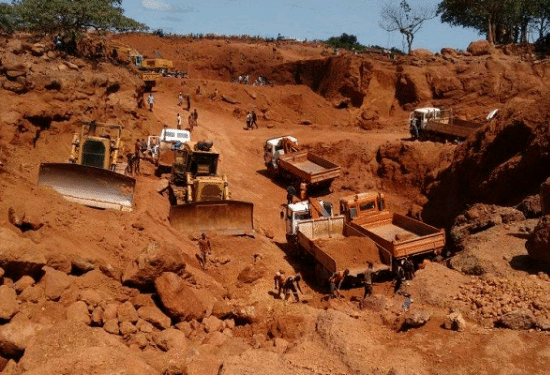
SIGUIRI, Guinea – Guinea’s authorities have launched a major enforcement operation targeting excavators, commonly known as “Poclain” machines, used in semi-artisanal gold mining activities across the gold-rich prefecture of Siguiri. The operation marks one of the strongest government interventions in recent years against what officials describe as uncontrolled and environmentally destructive gold mining practices.
According to local sources, the campaign extends beyond active mining sites. Excavators parked in various locations throughout the city have reportedly been seized and transferred to the Diarrala Infantry Camp under the supervision of security forces. The operation is being supported by special forces deployed to ensure compliance throughout the prefecture.
The move forms part of Guinea’s broader efforts to combat illegal and unregulated gold extraction, a challenge that has intensified as rising gold prices continue to attract operators to the country’s prolific gold-bearing regions.
Environmental Pressure Reaches a Critical Point
For many residents of Siguiri, the government’s intervention has been welcomed as a long-awaited response to escalating environmental degradation.
Over the past decade, the rapid expansion of semi-artisanal mining operations has transformed large areas of the prefecture. Heavy machinery introduced into what was traditionally artisanal mining has significantly increased production capacity but has also accelerated land disturbance, deforestation, river sedimentation, and the destruction of agricultural land.
Community members have repeatedly expressed concerns about abandoned mining pits, declining water quality, and the loss of fertile farmland that supports local agriculture. In several localities, mining activities have increasingly competed with farming for land use, creating tensions between economic opportunity and environmental sustainability.
The current crackdown suggests that authorities are responding to growing public pressure to restore environmental control in one of Guinea’s most important gold-producing regions.
A Complex Socio-Economic Challenge
While the environmental rationale behind the operation is widely understood, the situation in Siguiri highlights a deeper socio-economic dilemma facing Guinea’s mining sector.
For decades, artisanal gold mining served as the primary source of income for thousands of families across Siguiri. Following government restrictions and enforcement measures against traditional artisanal mining activities in recent years, many operators transitioned toward semi-artisanal methods involving excavators and mechanized equipment.
These operations created new income opportunities for equipment owners, contractors, transporters, fuel suppliers, and local workers. However, they also intensified environmental impacts and often operated outside formal regulatory frameworks.
The government now faces a difficult balancing act.
On one hand, communities demand stronger environmental protection and the preservation of agricultural land. On the other hand, thousands of households remain economically dependent on gold mining activities.
The removal of excavators may reduce environmental damage in the short term, but it also risks disrupting livelihoods unless viable economic alternatives are developed.
Can Industrial Mining Fill the Employment Gap?
Many local stakeholders argue that the long-term solution lies in attracting more formal mining investment and encouraging the expansion of industrial mining operations that comply with environmental standards.
Siguiri already hosts major industrial gold operations, including those led by international mining companies. These projects contribute significantly to national gold production, government revenues, and export earnings.
However, industrial mining has not fully absorbed the workforce displaced from artisanal and semi-artisanal activities.
A key challenge is the difference in workforce requirements. Modern industrial mines increasingly rely on skilled technicians, engineers, geologists, environmental specialists, heavy equipment operators, and other trained professionals. As a result, many positions are filled by experienced workers recruited from other regions of Guinea or from abroad.
For local communities, this creates a perception that industrial mining generates substantial wealth while providing limited direct employment opportunities for residents lacking technical qualifications.
The gap between local workforce capabilities and industry requirements remains one of the most significant barriers to achieving inclusive mining-led development in Siguiri.
The Need for a Transition Strategy
The current operation against excavators underscores the urgent need for a comprehensive transition strategy for Siguiri’s mining economy.
Industry observers note that enforcement measures alone are unlikely to provide a sustainable solution. Instead, a balanced approach could include:
- Formalization and regulation of eligible artisanal mining activities.
- Rehabilitation of degraded mining sites.
- Expansion of vocational and mining skills training programs.
- Greater local content initiatives by industrial mining companies.
- Development of alternative economic sectors, including agriculture and small-scale entrepreneurship.
- Strengthened environmental monitoring and compliance mechanisms.
Such measures could help bridge the gap between environmental protection objectives and the economic realities facing local communities.
A Defining Moment for Siguiri
Siguiri remains Guinea’s most important gold-producing region and a cornerstone of the country’s mining industry. The ongoing crackdown on mechanized semi-artisanal mining reflects growing recognition that unchecked gold extraction carries significant environmental and social costs.
Yet the operation also highlights a fundamental question confronting policymakers: how can Guinea simultaneously protect the environment, preserve community livelihoods, and maximize the benefits of industrial mining?
The answer may determine not only the future of Siguiri but also the broader sustainability of Guinea’s gold sector.
As authorities continue their enforcement campaign, stakeholders across the mining industry will be watching closely to see whether the initiative evolves into a broader strategy that balances environmental stewardship, local employment, and responsible resource development.
Share on social media

-