


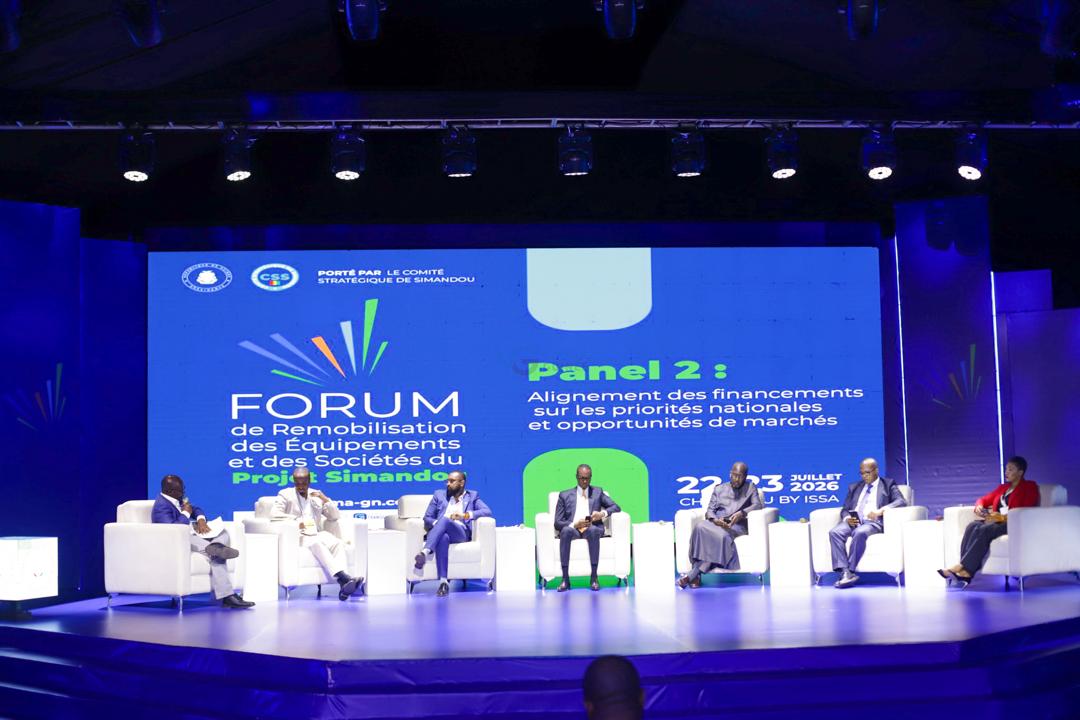
Conakry — With the Simandou mine-and-infrastructure project now substantially complete, Guinea's government has opened a two-day national forum aimed at a question few mining jurisdictions have had to confront at this scale: what happens to a multi-billion-dollar fleet of construction equipment, and the tens of thousands of workers trained to operate it, once the project that built it winds down.
The Forum on the Remobilization of Simandou Equipment and Companies opened Wednesday at Les Chapiteaux By Issa in Conakry, drawing government ministers, diplomats, investors and private-sector executives. The event, which concludes Thursday with practical workshops to formalize early partnerships, is being framed by officials not as a ceremonial send-off for Simandou but as the formal launch of what several speakers called "the post-Simandou era."
The Scale of What's at Stake
Guinea's Minister of Infrastructure, Facinet Sylla, laid out the physical inventory now sitting idle or winding down on Guinean soil: machinery that bored more than 22 kilometers of tunnels — including single bores exceeding 11 kilometers — plant that laid over 1,300 kilometers of rail corridor, and the heavy equipment that reclaimed port infrastructure from the swamps at Moribaya. Separately, the Minister Secretary General at the Presidency, General Amara Camara, cited a 650-kilometer rail line linking the ore deposits to the deep-water port, describing it as the logistics backbone of the entire corridor, alongside new roads, bridges and tunnels opening up the interior.
For an industry audience, the discrepancy in rail-length figures cited by different officials (1,300 km versus 650 km) likely reflects different scopes — combined multi-line trackage versus the core operating corridor — but it also underscores that Guinea is still consolidating a single, coherent public account of what was actually built. Mining actors tracking residual-asset opportunities should expect more precise figures to emerge from the forum's technical sessions rather than from political remarks.
The Policy Logic
Minister of Mines and Geology Bouna Sylla positioned the forum within the government's Simandou 2040 framework, describing the ambition to convert the project from a standalone mining operation into a platform for broader industrialization. He noted that the equipment and companies mobilized for Simandou represent capability drawn from firms across five continents — Chinese contractors, American locomotive suppliers, French signaling specialists, German crushing and processing equipment providers, Portuguese firms, and Guinean subcontractors — and argued that this concentration of technical capacity should not be allowed to leave the country now that the construction phase is ending.
The government's stated mechanism for retention is joint ventures between Guinean and international companies, rather than direct state acquisition of the equipment fleet. This is a meaningful signal for international contractors and equipment owners currently mobilized on Simandou: Conakry appears to be seeking negotiated local partnerships and asset redeployment agreements rather than nationalization or forced divestiture.
Minister François Faya Bourouno, credited by colleagues as the architect of the forum concept, framed the government's role as creating a favorable administrative environment for this reallocation of capital and expertise — an implicit acknowledgment that regulatory and bureaucratic friction, rather than lack of demand, is the primary risk to retaining the fleet.
Four-Point Roadmap
General Amara Camara outlined the forum's operational agenda: encouraging Simandou-linked companies to pursue opportunities beyond the mining corridor itself; capitalizing on already-mobilized equipment and expertise to keep them in-country; preparing the pipeline of structuring megaprojects under the 2040 development program; and strengthening public-private partnership mechanisms to ensure transparency and social impact.
What This Means for Mining Actors
For contractors, equipment lessors and logistics operators currently active on Simandou, the forum signals that Guinea intends to actively broker second-life opportunities for demobilizing assets rather than simply let contracts lapse — a potential channel worth engaging with directly through the B2B sessions the government has organized between entrepreneurs and capital providers.
For international investors eyeing Guinea's next wave of infrastructure — roads, rail extensions, and industrial projects tied to the 2040 program — the availability of a pre-trained workforce and battle-tested heavy equipment fleet, already proven on one of Africa's largest infrastructure builds, could meaningfully lower entry costs and de-risk mobilization timelines compared with greenfield projects elsewhere in West Africa.
The open question, which the forum's Thursday workshops are meant to address, is whether Guinea can translate ministerial rhetoric about retaining "technical, industrial and human capital" into binding commercial agreements before contractors' equipment leases expire and crews disperse to other regional projects. Mining actors with interests in the corridor would be well advised to monitor the outcomes of this week's B2B sessions closely, as they may define the terms of access to Simandou's residual capacity for years to come.
Share on social media

-