


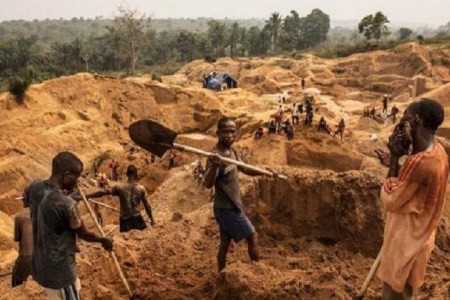
Siguiri, Guinea – June 8, 2026 – At least four miners have been confirmed dead following a major ground collapse at the Fidi artisanal gold mining site in Kintinian sub-prefecture, Siguiri Prefecture, highlighting once again the persistent safety challenges facing Guinea’s artisanal gold mining sector.
The accident occurred around 1:00 p.m. on Sunday, June 7, when a section of the mining pit reportedly collapsed, trapping workers and equipment beneath large volumes of earth and rock. According to local sources, rescue teams and volunteers recovered four bodies from the debris, while two tipper trucks remain buried under the collapsed material.
Witnesses at the site fear the death toll could rise significantly as search and recovery operations continue under difficult conditions. Preliminary reports suggest that more than ten people may have been trapped at the time of the collapse, although authorities have not yet released an official casualty figure.
Local government representatives and emergency services were expected to visit the site to assess the situation, coordinate rescue efforts, and secure the affected area.
A Familiar Tragedy in Guinea’s Gold Belt
The latest accident is far from an isolated incident. Siguiri, Guinea’s leading gold-producing region, has experienced numerous fatal collapses over the years, particularly at artisanal and semi-artisanal mining sites where safety standards are often inadequate or absent.
Artisanal mining remains a major economic activity across the prefecture, supporting thousands of households directly and indirectly through gold extraction, trading, transportation, equipment supply, and related services. However, the sector continues to be characterized by significant occupational hazards, including pit collapses, flooding, exposure to hazardous chemicals, and unsafe excavation practices.
Mining experts note that many artisanal operations are conducted without geotechnical studies, slope stability monitoring, or proper mine planning. As miners pursue increasingly deeper deposits, the risk of wall failures and catastrophic collapses rises substantially.
The Fidi tragedy serves as another reminder of the urgent need for stronger safety oversight and formalization measures within Guinea’s artisanal mining industry.
Siguiri’s Difficult Mining Dilemma
Beyond the immediate human tragedy, the accident also brings renewed attention to a complex socio-economic dilemma confronting Siguiri’s population.
In recent years, the Guinean government has intensified efforts to regulate and, in some areas, restrict artisanal gold mining activities. Authorities have justified these measures on the grounds of safety concerns, environmental degradation, and the need to improve governance of mineral resources.
Yet for many communities in Siguiri, artisanal gold mining has historically represented the primary source of income. Entire villages depend on gold extraction for their livelihoods, particularly in areas where alternative economic opportunities remain limited.
The challenge for policymakers is that the sector simultaneously provides economic survival and exposes workers to unacceptable levels of risk.
The collapse at Fidi illustrates the human cost associated with unregulated mining practices. Fatal accidents continue to claim lives every year, often involving young miners seeking income opportunities unavailable elsewhere.
Growing Concerns Over Semi-Artisanal Mining
At the same time, local communities have increasingly expressed concerns about the expansion of semi-artisanal mining activities across parts of Siguiri.
Residents frequently report that mechanized operations using excavators and heavy equipment contribute to environmental degradation, land disturbance, water pollution, and the destruction of agricultural land. Farmers have complained about the loss of fertile fields and reduced agricultural productivity as mining activities expand into rural areas.
The resulting tensions reflect competing priorities within local communities. While mining generates income and economic activity, it can also undermine traditional livelihoods, particularly agriculture, which remains a critical source of food security.
The challenge for regulators and operators is therefore not only to improve mining safety but also to ensure that mining development occurs in a manner that minimizes environmental impacts and protects community interests.
Industrial Mining: Economic Engine, Limited Local Employment
Siguiri is also home to large-scale industrial gold mining operations that contribute significantly to Guinea’s export earnings, tax revenues, and foreign investment inflows.
However, many local residents argue that industrial mining has not fully addressed employment expectations. Modern mining operations require specialized technical skills in geology, engineering, metallurgy, environmental management, health and safety, and equipment maintenance.
As a result, companies often recruit experienced professionals from other regions of Guinea or from abroad. While industrial mines generate direct and indirect jobs, local communities frequently perceive that the most qualified and highest-paying positions remain inaccessible to many residents of Siguiri.
This perception has fueled calls for greater investment in technical education, vocational training, and workforce development programs that could enable more local workers to participate in industrial mining careers.
The Way Forward
The deadly collapse at Fidi underscores the need for a balanced and inclusive mining development strategy in Siguiri.
A sustainable solution will likely require stronger enforcement of safety standards at artisanal sites, expanded formalization programs, environmental protection measures, and greater efforts to integrate local populations into the benefits generated by industrial mining.
For Guinea’s mining sector, the challenge is not simply choosing between artisanal and industrial mining. Rather, it is creating a framework in which mineral resource development contributes to economic growth while protecting human lives, preserving the environment, and generating meaningful opportunities for local communities.
As rescue operations continue at Fidi, the tragedy stands as a stark reminder that the future of mining in Siguiri must address both the economic realities facing local populations and the persistent risks that continue to claim lives in Guinea’s goldfields.
Share on social media

-