


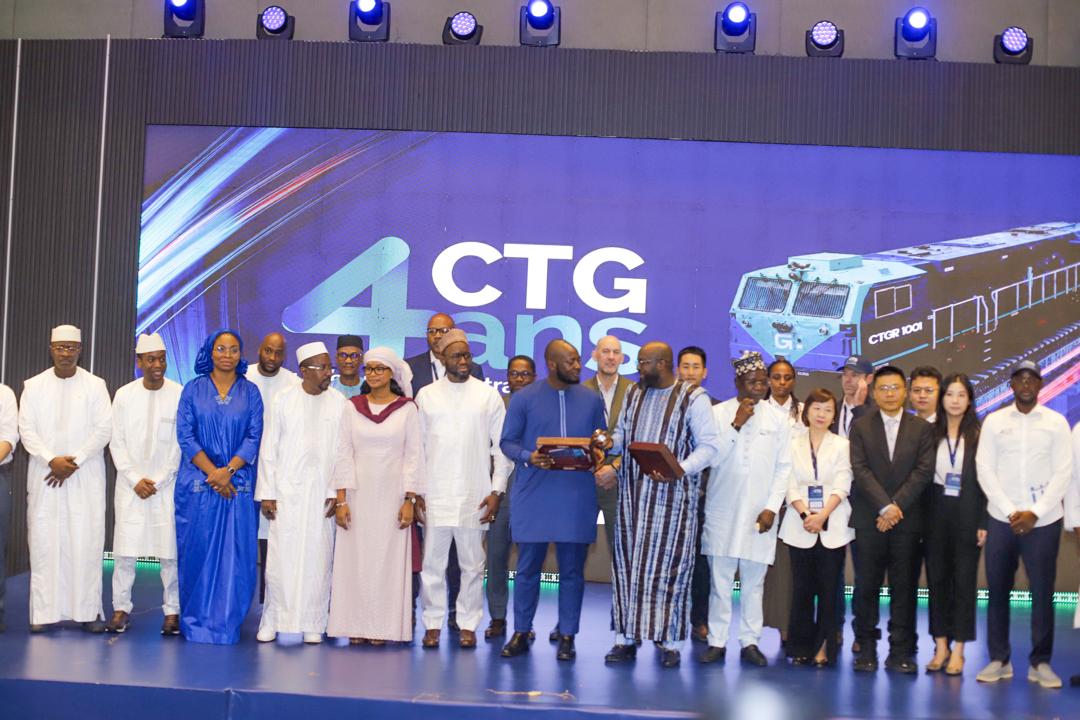
Conakry — The Compagnie du TransGuinéen (CTG) celebrated its fourth anniversary in Conakry on Friday, bringing together company staff, industrial partners including Rio Tinto Simfer and Baowu Winning Consortium Simandou (BWCS), and senior government officials under the theme "4 Years: On the Rails of Transformation." The event marked more than a corporate milestone — it signalled CTG's transition from project-development entity to the operational backbone of one of Africa's largest integrated mine-to-port infrastructure schemes.
From Project Company to Strategic Operator
Established in July 2022 to develop and operate the rail and port infrastructure of TransGuinéen corridor, CTG now oversees 650 kilometres of multi-user railway and Moribaya port complex, which includes two mineral berths with a combined design capacity of 120 million tonnes per year at steady state, plus a commercial quay handling 2.5 million tonnes of general cargo and equipment annually.
Deputy Managing Director Moussa Bérété detailed the company's rapid workforce expansion, from fewer than 10 employees in its third year to more than 120 today, over 70% of them Guinean nationals. CTG expects to surpass 400 employees by the end of 2026, with the same national-hire ratio maintained, and projects more than 3,900 Guinean jobs over the next three years. On local content, the company committed to spending over $500 million with Guinean enterprises over three years, alongside more than $25 million in institutional and technical-training support — part of a stated "Guinéisation" strategy that pairs expatriate managers with Guinean deputies for structured skills transfer into leadership roles.
Managing Director Robin Lu reinforced the company's stated ambition to become a "world-class Guinean logistics company," framing CTG's mission around retaining skilled labour domestically rather than losing it to outward migration, and pointing to a further 4,000 jobs to be created directly and indirectly through subcontractors over the coming three years.
A Multilateral Supply Chain
Mines and Geology Minister Bouna Sylla, CTG's first board chairman (2022–2024), traced the project's origins to the March 2022 co-development framework agreement that merged the previously separate Rio Tinto Simfer and Winning Consortium Simandou blocks at presidential direction — a consolidation credited with unlocking the scale needed for shared infrastructure. He also highlighted the international character of the supply chain: Australian and Chinese investors, American locomotives, French signalling systems, and German crushing equipment, converging on operations that began on November 11, 2025.
Insights for Mining Actors
For industry observers, CTG's anniversary messaging underscores three developments worth tracking. First, the corridor has now entered a tariffed, commercial operating phase, meaning rail and port pricing — not construction milestones — will increasingly define the economics for Simfer and BWCS offtake. Second, the scale of committed local-content spending ($500 million-plus) and hiring targets (nearly 4,000 jobs) sets a benchmark local suppliers and contractors may look to leverage, while foreign partners should anticipate deepening Guinean equity in management. Third, with 120 Mtpa of mineral handling capacity now operational at Moribaya, capacity utilisation and throughput reliability will be the key metrics for assessing whether Simandou's iron ore is reaching export markets at the pace envisioned under the government's Simandou 2040 vision.
Share on social media

-