


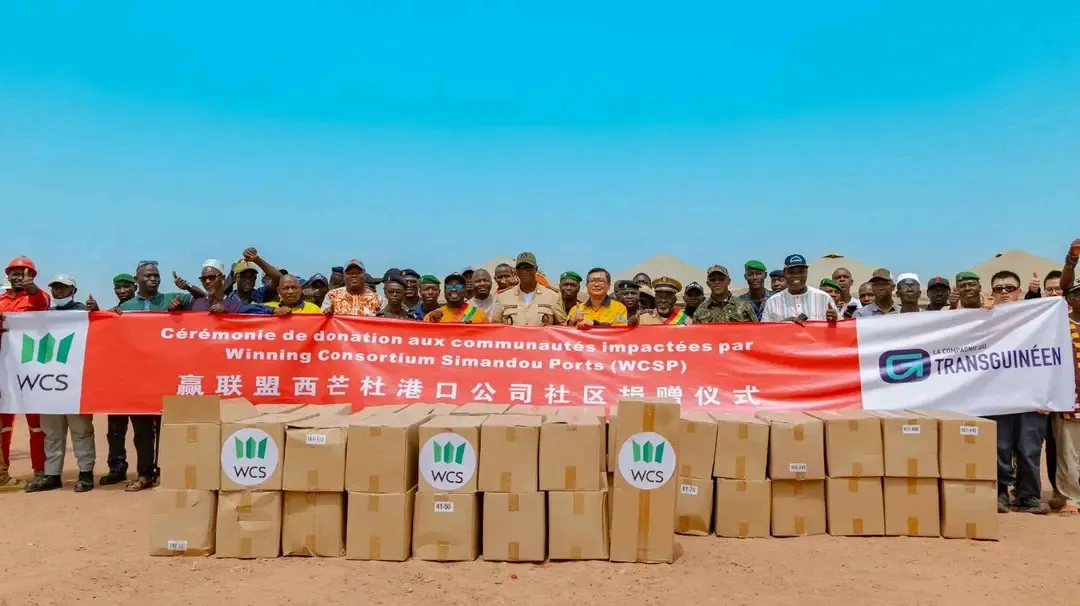
In a move aimed at strengthening maritime safety and fostering coexistence between industrial port operations and traditional livelihoods, Winning Consortium Simandou Port (WCSP) has launched a distribution campaign of radar reflectors for artisanal fishing communities located within the area of influence of the Simandou port infrastructure project.
The initiative forms part of WCSP’s broader community engagement and safety strategy as large-scale mining logistics infrastructure continues to develop along Guinea’s southern coastline. The inaugural distribution ceremony took place on 4 March 2026 in the fishing village of Touguiyiré, where 450 foldable radar reflectors were handed over to representatives of fishing ports from the Kaback and Maférinyah zones.
The event gathered local authorities and sectoral stakeholders, including the Prefect of Forécariah, Colonel Mamadou L. Diallo, alongside representatives from the regional directorates of Mines and Geology, Fisheries and Maritime Economy, Environment and Sustainable Development, and the National Maritime Authority (ANAM).
Speaking at the ceremony, the prefect commended the initiative as a practical step toward enhancing the safety of artisanal fishing operations while safeguarding the livelihoods of coastal communities operating in waters increasingly used by commercial shipping linked to major mining developments.
The distributed equipment consists of foldable radar reflectors, devices designed to improve the detectability of small fishing vessels on the radar systems of large ships. Traditional wooden fishing boats, which typically lack electronic navigation systems, are often difficult to detect by radar, particularly during low visibility conditions or night navigation.
With the rapid development of port infrastructure associated with the Simandou iron ore project, maritime traffic is expected to increase significantly in the waters surrounding Morebayah Port, a key export gateway being developed to support the evacuation of future iron ore production.
By enhancing the radar visibility of small vessels operating in the port channel and surrounding coastal areas, the reflectors help reduce the risk of maritime collisions between artisanal fishing boats and larger commercial or industrial vessels navigating the shipping corridor.
A second distribution phase was conducted on 5 March 2026 in the fishing locality of Kakossa, where an additional 50 radar reflectors were provided to local fishing ports. In total, 500 radar reflectors have been distributed under the initiative.
The equipment will be installed on traditional fishing boats operating in coastal waters around Morebayah, improving the safety conditions for fishermen who depend on these waters for their daily activities.
The Simandou project represents one of the largest mining infrastructure developments currently underway in West Africa, involving the construction of railways, ports, and logistics systems designed to support the export of high-grade iron ore from the Simandou range in southeastern Guinea.
As such large-scale projects reshape transportation corridors and coastal logistics hubs, maintaining constructive relationships with surrounding communities—particularly those whose livelihoods depend on shared maritime space—has become a key component of responsible project development.
Through initiatives such as the radar reflector distribution campaign, WCSP aims to promote safe maritime coexistence, community dialogue, and risk mitigation in waters adjacent to the Morebayah port zone.
For local fishing communities, the equipment represents a practical tool to improve navigation safety. For the Simandou logistics corridor, it contributes to building the operational conditions necessary for safe multi-user maritime activity in an increasingly strategic shipping route tied to Guinea’s emerging iron ore export capacity.