


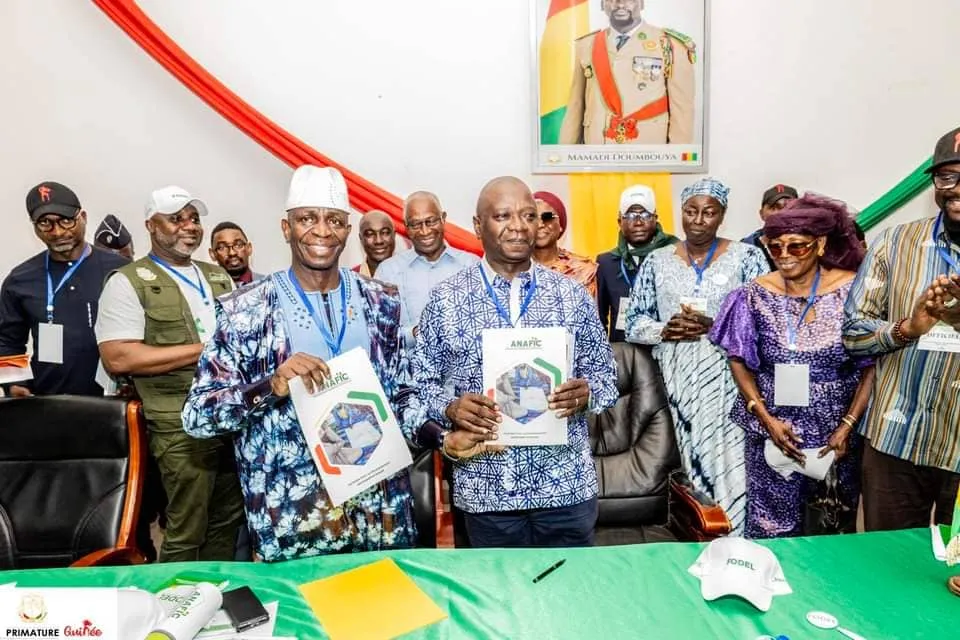
After more than two years of anticipation, the signing of the Type Convention for Local Development and the Joint Ministerial Decree MATD-MMG concerning the Local Economic Development Fund (FODEL) marks a turning point in Guinea’s approach to resource governance. The ceremony, held in Boké under the high patronage of Prime Minister Amadou Oury Bah, symbolizes the government’s renewed determination to transform mineral wealth into sustainable social and economic growth for local communities.
Understanding FODEL and Its Purpose
The FODEL (Fonds de Développement Économique Local) was created to ensure that the exploitation of Guinea’s vast mineral resources directly benefits the populations most affected by mining activities. Enshrined in Article 130 of the Guinean Mining Code, it mandates that all mining companies contribute annually to local development — 0.5% of turnover for bauxite and iron projects, and 1% for other minerals. These contributions are pooled into FODEL to fund community development initiatives in mining zones.
At its core, FODEL represents the Guinean government’s effort to balance mining-driven economic growth with inclusive, community-centered development. It seeks to channel a portion of mining revenues toward infrastructure, education, healthcare, and income-generating activities for women and youth — promoting social stability and shared prosperity.
Governance and Distribution Mechanisms
The recent joint decree between the Ministry of Territorial Administration (MATD) and the Ministry of Mines and Geology (MMG) provides updated governance rules and a transparent framework for fund allocation. The National Agency for Local Government Financing (ANAFIC) now plays a central role in managing and disbursing FODEL resources, ensuring alignment with national decentralization and development policies.
Funds collected through FODEL are distributed according to a structured formula designed to ensure fairness and impact:
- 35% to local governments hosting mining operations, proportionate to the land occupied;
- 25% to surrounding localities within the mining perimeter;
- 20% to communities identified as impacted through environmental and social studies;
- 15% to other local governments in the affected prefectures;
- 5% to regional and prefectural administrative services.
This distribution model seeks to prioritize the communities most directly affected by mining, while ensuring that surrounding areas also share in the economic benefits of the extractive industry.
Implications for Mining Companies
For mining operators, FODEL represents both a legal obligation and an opportunity to strengthen their social license to operate. By contributing to the fund and participating in its governance structures, companies can help mitigate social tensions, enhance local relationships, and demonstrate alignment with environmental, social, and governance (ESG) standards.
The government has emphasized transparency and accountability as key pillars of the new FODEL framework. Mining companies must ensure that their annual contributions are properly recorded and publicly disclosed, as stipulated by the 2017 FODEL decree. Furthermore, project implementation financed through the fund must be traceable, community-driven, and integrated into local development plans (Plans de Développement Local and Plans Annuels d’Investissement).
In practice, the fund’s efficient use can reduce community grievances, prevent production disruptions, and reinforce the long-term stability of mining operations. It also provides an avenue for companies to support non-mining sectors such as agriculture, vocational training, and environmental restoration — contributing to the diversification and resilience of local economies.
Challenges and the Need for Transparency
Despite its promise, FODEL has faced challenges since its inception. Reports of mismanagement, limited oversight, and delayed disbursements have occasionally undermined its credibility. The period following September 2021 saw a troubling lack of transparency, with little information publicly available regarding fund utilization or company contributions.
The newly signed decree and type convention aim to restore confidence by strengthening control mechanisms, mandating regular audits, and ensuring public disclosure of FODEL-related expenditures. With over 258 billion GNF reportedly allocated by mining companies between 2021 and 2022, renewed transparency is essential to guarantee that these funds translate into tangible improvements for local populations.
A Step Toward Sustainable Local Development
The relaunch of FODEL under the current administration signals a new era for community development in Guinea’s mining regions. By institutionalizing transparency, involving ANAFIC in fund management, and aligning local projects with national priorities, the government seeks to ensure that mining becomes a genuine driver of inclusive growth.
For mining companies, this evolving framework presents a strategic opportunity to reinforce their commitment to responsible mining and to demonstrate measurable contributions to Guinea’s social and economic development. If effectively implemented, FODEL could serve as a model of shared value creation — where mining revenues fuel infrastructure, education, and entrepreneurship, laying the foundation for lasting prosperity across Guinea’s mineral-rich territories.