


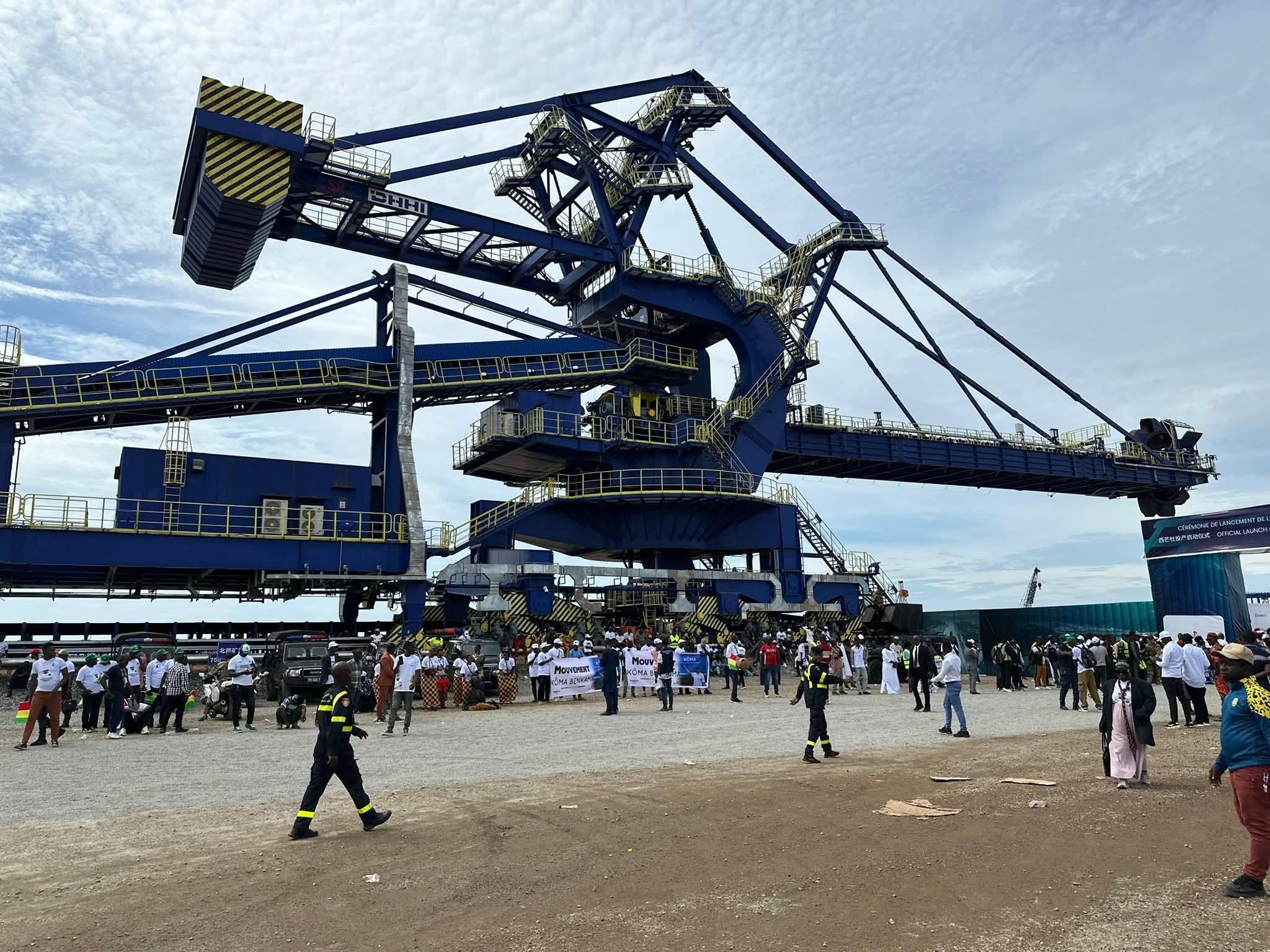
Forécariah, Guinea – Guinea marked a defining moment in its mining history on 11 November 2025 with the official start of production at the Simandou iron ore project, one of the world’s most anticipated and complex mining developments. The launch ceremony, held at the newly built Moribaya port in Forécariah, brought together the President of the Transition, General Mamadi Doumbouya, heads of state from Rwanda and Gabon, China’s Vice Premier, shareholders from Rio Tinto, Chinalco, Baowu and Winning, as well as senior Guinean officials.
The event signaled more than the commissioning of a mining project. For industry observers, Simandou represents a complete reconfiguration of Guinea’s mining infrastructure, a long-term commercial opportunity for global steelmakers, and a new model of state participation.
Infrastructure on a Transformational Scale
At the ceremony, Mamoudou Nangnalén Barry, Chairman of the Board of the Compagnie du TransGuinéen (CTG), highlighted the scale and strategic design of the infrastructure delivered in record time. He reminded the audience that three years ago, Moribaya was “a marshland and abandoned forest,” a far cry from today’s multi-port hub.
The CTG now owns and operates:
- 1,300 km of rail infrastructure built along a 650 km corridor, engineered for both mining and general freight
- Two bulk export ports and one commercial port, with a combined minimum capacity exceeding 120 million tonnes per year
- A multi-user, multi-purpose rail system designed to integrate other mining operations and facilitate passenger and agricultural transport
For mining companies, the multi-user railway is one of Simandou’s most significant industry implications. It opens the path for operators in southeastern Guinea to evacuate ore through a world-class corridor without the need for standalone export logistics. This reduces project risk, lowers capital intensity and accelerates potential development timelines for future iron ore, bauxite, and polymetallic ventures along the Simandou spine.
A Strategic Pivot Toward Value Addition
Barry also confirmed that Guinea is already preparing for the next phase: onshore mineral transformation. Feasibility studies for an iron and steel plant, or pelletizing facility, will begin within two years, in line with directives from the presidency.
For mining investors, this signals that Guinea intends to capture a larger share of the iron ore value chain, potentially reshaping market dynamics for high-grade feedstock in West Africa. Companies evaluating projects in Guinea will need to factor in the future policy environment, especially concerning beneficiation obligations and local processing incentives.
Simandou 2040: Mining as a National Development Engine
In his address, Djiba Diakité, Minister, Chief of Staff to the Presidency and President of the Simandou Strategic Committee, placed Simandou at the heart of Guinea’s long-term socio-economic strategy. The Simandou 2040 Program, built around five pillars including infrastructure, education, technology and agriculture, sets an ambitious target: transform Guinea’s mineral wealth into national industrial capacity and human capital.
According to Diakité, each tonne of ore extracted is “a brick in the construction of our future,” and each kilometer of track “a step toward our collective destiny.” He emphasised three binding local content pillars that mining companies operating in Guinea will need to align with:
- Employment and Skills Development
- Priority recruitment of Guineans
- Accelerated skills transfer
- Strengthened technical schools and university partnerships
- Launch of the Simandou Academy, designed to train mining operators, engineers, and logistics specialists
- Local Supply Chains
- Expanded access for Guinean contractors in logistics, civil works, maintenance and technical services
- Contractual frameworks that support both global standards and national expertise
- Inclusive Regional Impact
- Rail and port infrastructure must also improve the lives of local populations
- Freight capacity for agricultural products to boost regional markets
The first train—symbolically flagged off at 11:11 a.m.—was driven by a Guinean woman trained locally, a milestone highlighted by Diakité as proof of the country’s commitment to building a domestic mining workforce.
Partnership Model: A New Template for Global Mining
Rio Tinto CEO Simon Trott described Simandou as a “catalyst for development” and a model of complex, multinational partnership. The project unites five continents, a point repeatedly emphasised by Guinean authorities as a strength of the co-development model. Trott paid tribute to the thousands of Guinean workers who contributed to the construction phase, and acknowledged the workers who lost their lives, stating that safety remains the company’s highest priority.
Trott reaffirmed Rio Tinto’s long-term commitment to Guinea, highlighting that the consortium’s collaboration with the Guinean state represents a new standard for how global miners can co-develop strategic infrastructure with host governments.
For mining companies globally, the Simandou partnership illustrates an emerging model:
state equity + multi-party infrastructure + binding local content = social license and operating stability.
A President Focused on Legacy and Long-Term Stewardship
Diakité revealed a personal confidence shared by President Doumbouya during early negotiations. The President had insisted that the team move at the right pace, even stating he was willing to halt the process if national interests and environmental standards could not be fully safeguarded:
“If you cannot guarantee this, come to me. I will stop. I am not in a hurry. Another president will do it.”
For the mining sector, this message is clear: the Guinean government intends to follow a high-standards approach to resource governance, prioritizing environmental protection, long-term value capture and equitable partnerships.
Industry Implications: What Mining Companies Should Watch
As Simandou enters production, several trends are becoming evident for mining investors and operators:
- Logistics capacity will redefine project economics: The new corridor changes the viability of several dormant or early-stage iron ore and polymetallic deposits in southeastern Guinea.
- Local content obligations will become more stringent: Companies will need robust training programs, supplier development plans, and transparent reporting.
- Future policy incentives may favor beneficiation: With steelmaking studies underway, Guinea is likely to encourage downstream processing, aligning with broader African industrialization goals.
- Community expectations will rise: As Simandou becomes a national symbol of development, other mining projects will be measured against its social impact contributions.
- Partnership with CTG will be central: Access to rail and port infrastructure will depend on alignment with CTG’s multi-user governance framework.
A New Chapter for Guinea’s Mining Future
The departure of the first Simandou ore shipment to China marks more than the activation of a high-grade export stream. It inaugurates a mining corridor that may become one of the most influential in Africa, reshaping national infrastructure, foreign investment flows and regional development.
For mining actors watching West Africa, Guinea has sent a strong message: it is positioning itself not only as a mineral-rich jurisdiction, but as a strategic industrial hub willing to engage in complex, long-term partnerships.
As Simon Trott concluded, “We are here for the long term, committed to the people, the communities and the future of Guinea.”
The world’s miners will now be watching how this commitment evolves as Simandou begins its next chapter.