


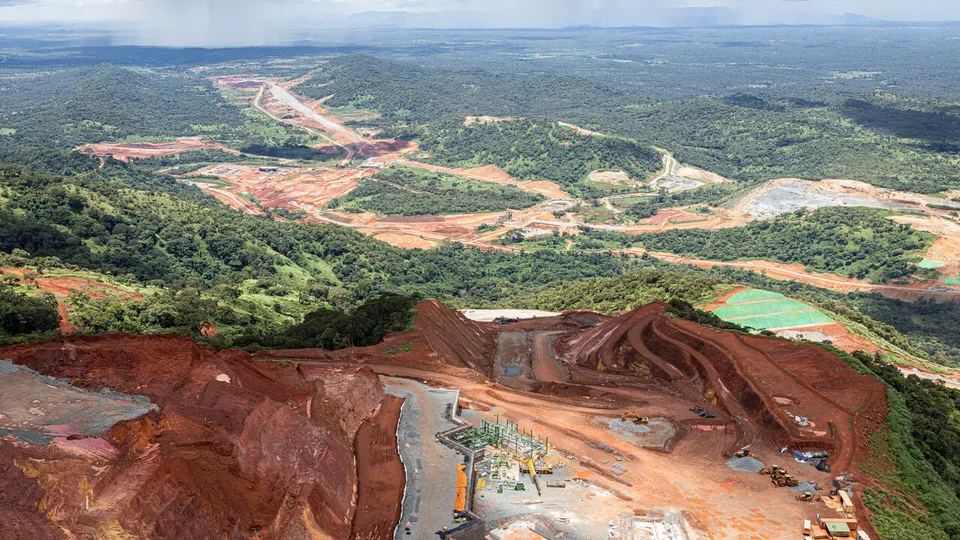
The Economist’s article, “A giant iron-ore mine could bring Guinea riches or ruin,” published on December 7th, 2025, offers a concise yet powerful examination of the long-awaited launch of iron-ore exports from Guinea’s Simandou deposit—one of the most coveted mineral assets on the planet. After nearly three decades of delays stemming from political instability, legal disputes, and infrastructure bottlenecks, the article highlights the historic departure of the first shipment on December 3rd, destined for China. This moment marks not only a milestone for Guinea’s mining sector but also a pivotal economic inflection point for the country.
The core argument of the article is cautionary: the sheer scale of Simandou’s potential wealth—estimated at $315 billion at current market prices—could either transform Guinea into a global mining powerhouse or entrench it deeper into governance challenges and political fragility. The Economist underscores that, in resource-rich states with weak institutions, such megaprojects often exacerbate corruption, inequality, and conflict rather than fostering development. With Guinea currently under military junta rule, the authors raise a legitimate concern: Will this mining windfall be managed transparently and sustainably, or will it replicate the grim “resource curse” pattern seen elsewhere in Africa?
The article also brings attention to the geopolitical dimension of Simandou. China’s deep involvement—through financing, engineering, and infrastructure development—creates both opportunity and dependence. The new 600-km railway and modern port, built mainly with Chinese support, could unlock massive economic spillovers, yet they also position China as the dominant power in Guinea’s mineral economy. The Economist hints at the strategic reality: Guinea’s leaders must navigate Beijing’s influence carefully to maintain sovereignty over the project and its benefits.
Another important theme is environmental and social risk. Simandou lies in a biodiversity-rich area, and large-scale mining threatens forests, watersheds, and rural livelihoods. The article emphasizes that the rapid pace of extraction, if not balanced with rigorous standards, could leave lasting ecological damage. Local communities, historically marginalized in mining regions, may face displacement or limited economic benefit unless robust safeguards are implemented.
Overall, the Economist’s analysis is balanced—celebratory of the historic breakthrough but sober about the political, economic, and environmental risks. The article serves as a warning and a roadmap: Guinea’s future hinges not on the size of its mineral deposits, but on the governance choices made in this pivotal moment.
Insights and Recommendations
For Mining Actors
- Adopt rigorous ESG standards to maintain social license to operate. Community engagement, local employment, and environmental protection will reduce operational risks and international criticism.
- Promote transparent revenue reporting, such as EITI compliance, to build trust with the Guinean public and government.
- Develop local content strategies—support vocational training, local suppliers, and technology transfer to build sustainable capacity.
For the Guinean Government
- Create a transparent revenue-management framework, similar to Ghana’s petroleum fund or Botswana’s diamond model, to avoid mismanagement.
- Stabilize regulatory institutions so that mining policy is predictable beyond the current junta period.
- Invest the mining windfall in long-term assets: electricity, education, water, digital infrastructure, and industrial diversification.
For the Guinean Population
- Monitor public spending and demand accountability through civil society, media, and community organizations.
- Leverage opportunities in local supply chains—construction, transport, services, agriculture linked to mining.
- Advocate for environmental protection and community rights to ensure development does not come at the cost of livelihoods.