


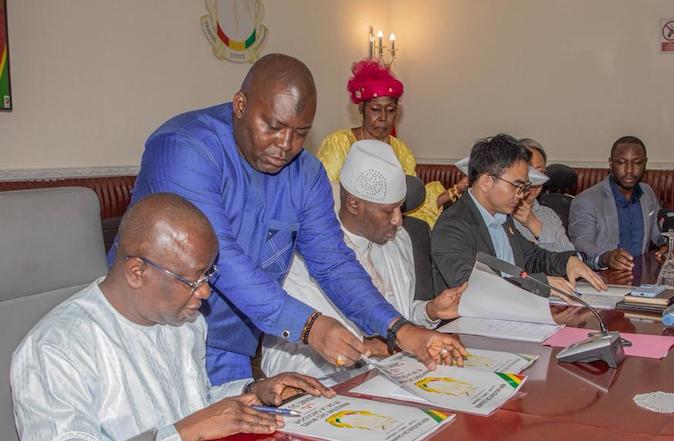
In a landmark move for Guinea’s mining infrastructure policy, the Ministry of Mines and Geology hosted the official signing ceremony of the Agreement for the Mutualization of the Dapilon Line Mining Road on Friday, October 3, 2025, in Conakry. The event marks a decisive step in the government’s broader strategy to promote shared and sustainable use of mining infrastructure across the country.
The ceremony, presided over by the Minister of Mines and Geology, brought together key institutional and industrial stakeholders, including the National Agency for Mining Infrastructure (ANAIM), SOGUIPAMI, the Guinea Chamber of Mines, and leading mining companies operating along the northwestern corridor — Ashapura, TBEA, Dynamic Mining, SMB, KBM, and CDM-Chine.
A Turning Point for Shared Mining Infrastructure
The newly signed agreement establishes a framework for joint management, operation, and maintenance of the Dapilon Line mining road, located in Boké Prefecture. This road serves as a vital logistics artery for the transport of bauxite and other minerals from several concessions in the region.
Through this mutualization initiative, mining operators aim to reduce investment and operational costs, minimize environmental impact, and enhance local economic and social benefits. Speaking at the ceremony, the Minister of Mines and Geology emphasized the agreement’s strategic and symbolic importance for Guinea’s mining governance:
“This agreement reflects the Government’s commitment to fostering responsible mining development, rooted in transparency, sustainability, and solidarity among all stakeholders,” the Minister stated.
ANAIM to Ensure Coordination and Compliance
As the public agency responsible for the planning and regulation of mining infrastructure, ANAIM will play a central role in overseeing the implementation of the agreement. The agency will ensure the equitable access, proper maintenance, and transparent coordination of road usage among mining companies.
ANAIM’s Director General, Mr. Aly Damalaye Condé, hailed the signing as a milestone in Guinea’s path toward collaborative infrastructure governance:
“This mutualization represents a first in the shared management of mining roads in Guinea. It embodies the vision of His Excellency General Mamadi Doumbouya to make the mining sector a driver of economic sovereignty and sustainable development,” Mr. Condé remarked.
Under ANAIM’s supervision, the initiative will prioritize regular maintenance, non-discriminatory access for all users, and efficient communication between operators and regulatory bodies.
A Model for Sustainable Industrial Cooperation
The Dapilon Line agreement is expected to serve as a model for future infrastructure partnerships, aligning with Guinea’s national policy on the mutualization of mining corridors — including railways, ports, and roads.
For the northwestern corridor, home to some of the country’s most dynamic bauxite projects, this development signals a new era of cooperation between the state and private operators. By pooling resources and responsibilities, the parties aim to ensure that infrastructure development contributes not only to mineral exports but also to broader national and community development goals.
As Guinea continues to modernize its mining sector, the Dapilon Line mutualization stands as a strong example of how collective infrastructure management can enhance efficiency, sustainability, and equitable growth — setting a precedent for the future of mining in the country.